The Analysis

Sunday, August 24, 2008

NOT ALL ARABS ARE DESCENDANTS OF THE PROPHET

Sunday, 24 August 2008 11:37


Datuk Syed Rahman started off by saying that the IGP had called him and told him that if Najib ever becomes the Prime Minister then he had better leave the country.

NO HOLDS BARRED

Raja Petra Kamarudin

“Raja ada di mana?”

It was my old friend from the Parti Keadilan Nasional days, Zahid Md Arip, on the line. He did not have to even mention who was calling. His very loud “Sang Terubung Raja Petra Anak Raja Bugis” was a good enough introduction. And there was no mistaking who I was speaking to. Zahid had a certain ‘trademark’ that could almost be patented like the sound of a Harley Davidson exhaust pipe.

“I’m at the Bangsar Shopping Centre,” I replied in Bahasa Malaysia.

“How long are you going to be there?” he asked, also in Bahasa Malaysia.

“Not sure. Maybe another hour or so.”

BANGSAR SHOPPING CENTRE

“Can we come and see you? Someone wants to meet you. His name is Datuk Kamal Amir. Hold on, I’ll pass the phone to him.”

“Hello, Kamal Amir here. I would be most honoured if I can meet you. Can we have tea today?”

“Sure, no problem. What time you want to come here?”

“Where are you now?”

“Bangsar Shopping Centre.”

“Wah. Itu tempat orang kaya,” Datuk Kamal Amir joked. “I can be there in one hour. Is that too late?”

“Actually I’m almost finished. But never mind. I will wait for you.”

“Where to meet?”

“Come to the Dome.”

“Who was that?” my wife asked me.

“Not sure. Someone called Datuk Kamal Amir. Zahid’s friend.”

“Who is he?”

“Not sure. Must be someone important though. Zahid only mixes with important people.”

Zahid is the late Tun Ghafar Baba’s grandson and onetime Acting Youth Chief of Parti Keadilan Nasional during the time Ezam was in prison. He is one of those dubbed ‘The Dirty Dozen’, the twelve Parti Keadilan Nasional Youth leaders who crossed over to Umno just before the 2004 general election.

Politically, Zahid is ‘the enemy’. But I still maintain a cordial relationship with him in spite of our ‘political differences’, as I do with his uncle, Tamrin Ghafar, who I have no problems with and meet from time-to-time in the Bangsar Village for tea and sandwiches.

It was more than an hour before Zahid arrived and I was already feeling quite bored with all the waiting. Datuk Kamal was not with him. “Datuk is still in a meeting,” said Zahid. “He is coming along shortly.”

Datuk Kamal arrived about half an hour later. I expected someone big and intimidating, the sort of image you would expect from an Umno datuk. But Datuk Kamal was a small and very decent-looking sort of fellow. Not at all the normal Umno slime-ball and scumbag I had expected.

We hit it off in a mere five minutes and thereafter were chatting away as if we have known each other for years. They say the first few minutes are crucial. Either you take to each other or you do not. That goes for interviews as well. You have to impress the interviewers on the first take. The first impression counts and 50% of whether you get the job or not would depend on this. Thereafter, how you conduct yourself would either seal the job or you get shown the door.

We talked about everything in general and nothing in particular. It was, after all, a first meet, sort of a ‘getting to know you’ session.

“Hai, Datuk,” Datuk Kamal waved at someone walking by. The Datuk waved back and smiled and tried to hurriedly walk off. “Marilah duduk sebentar,” Datuk Kamal said while gesturing to an empty chair beside me.

This Datuk appeared hesitant and looked like he was not sure whether to accept the offer or instead just give an excuse and scurry out of there. But those who know Zahid would know that he is one persistent fellow who never takes ‘no’ for an answer. There was no way this Datuk was going to ‘escape’ and he knew it. So he sat down, whether that was what he really wanted to do or not.

I was introduced to this new Datuk. “Inilah Datuk Syed Rahman,” Datuk Kamal said as I shook hands with him. Datuk Kamal probably saw in my face that the name did not ring a bell. He looked Indian, as some Arabs do, and if I had not been told he was a ‘Syed’ I would have thought he was just another of those millions of Mamaks running around all over the country and making a nuisance of themselves.

“This is the Honorary Council of Mongolia,” Datuk Kamal said. My face still did not show that I recognised this Arab. “You know, the Altantuya murder case.”

“Oh, that’s right.” Now I knew whom this Datuk Syed Rahman is. He is that man always on TV beside Dr Sharriibuu Setev, Altantuya’s father. I inched closer to Datuk Syed Rahman Alhabshi, now that I knew who he is. “Interesting,” I said. “I’m sure you can tell me a lot about the Altantuya murder which the newspapers are not reporting.”

“That would be dangerous talking to you,” Datuk Syed Rahman replied. “You will quote what I say in Malaysia Today.”

“No, I won’t mention your name,” I joked. “I’ll just say the Honorary Council of Mongolia who wishes to remain anonymous.” There was laughter all around the table.
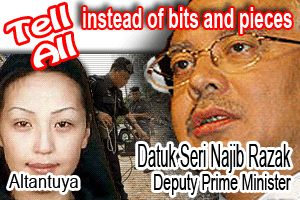
Datuk Syed Rahman started off by saying that the IGP had called him and told him that if Najib ever becomes the Prime Minister then he had better leave the country. “But I don’t care. I have told the Mongolian government that I want to buy a piece of land there and move to Mongolia. I don’t mind even giving up my Malaysian citizenship and settle down in Mongolia. So I don’t care what they want to do to me.”

“Why not then reveal what you know?” I asked. “What is stopping you from talking?”

“It is not that I’m scared. It is just that the court case is going on so it would be sub judice for me to talk about the issue. Plus, as the Mongolian Council, I need to be professional and not simply talk.”

Nevertheless he did talk, and talk a lot on top of that, after I assured him that nothing would be reported in Malaysia Today and that his name would not be mentioned.

But that was before this. Now that he has gone on national TV and has acted very unprofessionally and unbecoming of a man of his status by ‘spilling his guts’ and lying on prime-time TV, then my ‘deal’ with him is now off. He has opened his mouth and has ‘testified’ on TV about what he knows about the Altantuya murder. I was prepared to keep his secret as long as he too keeps his secret, secret. But since he has now revealed all, then I too should not be bound by any ‘official secrets’ since these secrets are no longer secrets.


Datuk Syed Rahman’s shocker was about them finding the remains of seven or eight people at the murder site. “What? Seven or eight people? You mean Altantuya was not the only one murdered and dumped at that site?”

“Those two UTK are assassins. Their job is to get rid of people. And that murder site is the place where they get rid of the bodies by blowing them up.”

“Wow! This is dynamite.” For once I was flabbergasted and there is very little that can shock me.

“Not dynamite. C4,” joked Datuk Syed Rahman.

“Tell me,” I moved closer to Datuk Syed Rahman. “Did Najib order her murdered?”

“No, not Najib, Rosmah. She ordered the murder.”

“What? Rosmah?” I could not believe it. Datuk Syed Rahman smiled; pleased that at least for once someone could shock Raja Petra who never normally gets shocked by anything.

Datuk Syed Rahman related in great detail what really happened. And what he related was a far departure from what transpired in the trial. Unfortunately, because commenting on an ongoing trial is considered sub judice and can attract a jail sentence, I am certainly not at liberty to also reveal in great detail what this Arab told me. And what he told me was very different from what he said on TV last night.

Maybe one day, when the trial is over, I will be ‘free’ to talk about what Datuk Syed Rahman revealed in the Dome of the Bangsar Shopping Center that day, more than a year ago. But whether I will be ‘free’ in the real sense of the word or whether I will be speaking from behind the high walls of the Sungai Buloh or Kajang Prison is left to be seen. Maybe, after 16 September 2008, I will know.

In the meantime stay tuned to learn more about what the Honorary Council of Mongolia, Datuk Syed Rahman Alhabshi, revealed in 2007 in the Dome of the Bangsar Shopping Centre. The story is nothing short of what Hollywood movie scripts are made of.

Wednesday, August 20, 2008

MARA is progress not fascism


by Azly Rahman dr.azly.rahman@gmail.com
http://azlyrahman-illuminations.blogspot.com/

Mara means “to advance (forward)”. It is the opposite of “retreat” and the declaration of defeat. It does not mean Undur.

Universiti Teknologi MARA (UiTM) must live up to its name. So must its younger brother Maktab Rendah Sains MARA. It is in the interest of the public to suggest good ideas for reform - and to advance.

In my lifetime I have been affiliated with both organisations. I taught in the former institution and I was schooled in the latter. Whether a product of historical accident or not, I am proud of my experiences in both. There is a reason for things to happen. I came from a poor family and was given the chance to have an education I wish many more Malaysians, my parents included.

But I wish to share my view on this troubling phenomenon that is plaguing a certain segment of the Malays. My argument will be largely linguistic.

What is the Malay view of the recent protest of UiTM student - of those young “men-in-black” whose are mourning and calling for the death of reason and rationality and for critical sensibility?

I think Malays in general are angry at the protesters. I think they are embarrassed that those few thousands of Malay students were displaying their ignorance of what Universiti Mara means.

While other universities have advanced (sudah mara ke hadapan) and are proud that they are embracing diversity and sharing resources for the benefit of deserving children of all races, those protesting UiTM students are experiencing the opposite.

They are yelling with pride the word “defeat” and “retreat”. Instead of Ayuh Mara they are actually saying Jom Undur. While thinking needs to advance, these students are saying that they need to digress (Ayuh… mari mundur ke belakang). Mundur is the derivative word.

Should a university embody the philosophy of mundur rather than mara? Should it even be proud of being and embodiment of that philosophy? I doubt it. Only a misguided leader will be proud of being a guide to ‘defeat and retreat’ while the world around ‘advances’ and moves.

But these students are not entirely at fault. It is the ideology and perpetrators of the ideology of undur itself that’s at fault. It is the leaders implementing the retrogressive ideology that are at fault.

It is the systematic indoctrination programme of ketuanan Melayu run over the decades that are advancing this UiTM philosophy of retreat.

It is an overdose of the work of government-sponsored Biro Tata Negara (BTN) that is making the mass retreat and defeat possible. It is the work of Malay-dominated agencies like these that are imprisoning the minds of the Malays. This is an anti-Malay-progress establishment that is using deformed arguments on race and ethnicity to pursue an educational ideology that has gone bankrupt.

Docile Malay intended

This is an anti-Malaysian mode of thinking that is still allowed to shackle the mind of the Malays. The idea is simple: make the Malay mind docile and afraid to think and you will divide and conquer them.

UiTM students need to instead protest against the continuing oppression they are experiencing through the work of their own institution and through BTN. They should demand that multiculturalism instead of blind nationalism be made the foundation of their college experience. UiTM students are more intelligent than those who protested against the suggestion.

In the 1980s UiTM’s (then ITM) orientation programme used to be conducted using the tactics of sheer humiliation and stupidity; meant to stupefy the young, bright Malay minds.

The ROTU (Reserve Officers Training Unit then) was part of the week-long organisers of the orientation to create an awareness of how ITM students must learn to live in a tough and challenging environment.

Senior students would prey upon the incoming freshmen to make them ‘tough’ through humiliation – name-calling, physical threats, psychological abuse, etc. Minggu Orientasi (Orientation Week) is a week for the seniors to have control over the mind of the Malays; oftentimes in a gangsterish way.

Of course, it is also the time for the senior boys to show toughness to the young girls in this ‘big brother-little sister’ game of tough love. Many of them fell involved with each other in this ‘Master-Slave’ relationship. Even senior girls prey upon young boys, acting rough and tough on them. Pathetic paternalistic philosophy in progress.

At times the freshmen would be roughened up by students in army boots and told to just follow instructions if they are to survive in ITM. They will be screamed at for trying to speak up. This is the ideology of ketuanan Melayu at work; how to enslave the mind of the young Malays and continue to do so through the hidden curriculum designed by those who wish to have control over the mind of the bright young and eager-to-learn Malays.

Instead of teaching the in-coming students how to take good notes, listen to lectures, speak up in public, pay extra attention to English Language, and be open to new ideas, respect each other, and learn from other cultures, the Malay students are subjected to humiliation in a place that called itself a university.

Retrogressive ideologies

In MRSM as well, a predominantly Malay-elite secondary institution for the best and brightest young Malays, similar things have been happening since the 1980s as well. Kursus Kesedaran (Self Awareness Courses) are conducted to instill the questionable idea of Ketuanan Melayu, making the children afraid of “Malaysian boogeymen and boogeywomen” and their own shadows.

Open-mindedness is rarely encouraged and students take control over each others’ lives transplanting retrogressive ideologies into each other’s head, with the help of ultra-nationalist and anti-multiculturalist teachers.

Even if these children survive the ideological ordeal and experience ‘tough love’ and go on to get their degrees from top American and British universities, they will still be Malays with a shallow understanding of multiculturalism or become more sophisticated Malays with more complex arguments on Ketuanan Melayu.

They will then design policies to affect the needed sustenance of ideology in order to protect the interests of the few. Neo-feudalistic cybernetic Malays are then new creation of the political-economic ruling class. They run the country and many are now running it down.

As an educator wishing to see Malays progress alongside in peace and prosperity with other races, I call upon us all to put a stop to all forms of indoctrination held especially by the BTN; an organisation that is of no value to the advancement of the Malays they claim to want to liberate.

It should be taken over by progressive Malaysians and replaced with a systematic effort to promote not only racial understanding through teaching respect and deep reflection on the cultures of the peoples of Malaysia, but also teach conflict resolution and mediation through cross-cultural perspectives. All must question the presence of BTN on campuses. All must reject BTN’s programme for indoctrination.

Let us no longer allow any government body of that sort to set foot on our campuses or our schools. As Malaysians we have to demand an end to the further dissemination of racist ideologies.

Open up, not only UiTM and MRSM but also Umno to more cultures. We will have a great celebration of diversity and respect for human dignity in decades to come. I speak as a silent reproduction and capitalised human of both MRSM and UiTM; a product of the human capital revolution of the Mahathir era.

MARA means progress. Malays are now sick of contradictions and doublespeak. They do not wish to Undur. Let us all protest against the stupefication of the Malays. Let us dismantle racist institutions.

Monday, August 18, 2008

Last Chance To Save Malaysia!

by M. Bakri Musa
August 17th, 2008

Before last March 2008 elections, I urged Kepala Batas voters to perform a great national service by booting out Prime Minister Abdullah. That would have triggered a seismic shift in UMNO’s leadership. With its ban on contesting top posts effectively circumvented, the party would get to preview other potential candidates.

If Kepala Batas voters were to shy away from exercising that historic opportunity, I suggested that Malaysians could still teach Abdullah a lesson by substantially reducing his coalition’s victory. That would also trigger a challenge to his leadership, and we would have the same effect as with the first scenario.

Alas, Malaysians did teach Abdullah a hard lesson, but not hard enough. Besides, being a slow learner, Abdullah did not get the message. Now voters in Permatang Pauh, practically next door, will get a chance to deal Abdullah a third and final knock-out blow, one he would surely get.

This upcoming by-election will be more than just electing the area’s representative to Parliament. Permatang Pauh voters will get the unique opportunity to decide on behalf of entire Malaysia on who will lead our nation. It is as much an opportunity to vote for Anwar Ibrahim as it is against Abdullah Badawi, and to vote for Malaysia’s future – on whether she would progress to join the developed world or continue its present path to join the likes of Zimbabwe.

Anwar Versus Abdullah

In Abdullah we have a dull and apathetically detached leader who exploits the differences among us in order to remain in power. In Anwar we have a charismatic leader well regarded especially internationally. He nurtures our commonalities and challenges us to rise above our differences.

Abdullah’s “I am Prime Minister for all Malaysians” utterance rings hollow when he allows, nay encourages the racist taunting of UMNO Youth leaders. Again illustrative of his opportunistic and exploitative character, right after the March elections when his party’s position was threatened in many states, he initiated a series of secret meetings with the opposition PAS. In so doing he showed contempt for his Barisan coalition partners.

Abdullah was also insensitive, or more accurately contemptuous of the feelings of those non-Malays who voted for his Barisan candidates, UMNO and non-UMNO alike. The rewards he dangled must have been quite substantial to tempt the otherwise self-righteous PAS leaders to participate in those talks. Fortunately wiser heads prevailed in PAS; the futile discussions were aborted.

Anwar does not have as yet a formal leadership role. Yet as adviser to PKR he successfully created a viable coalition effective enough to deny Barisan its two-thirds majority in Parliament and dislodge it in five states, including such major ones as Perak, Penang, and Selangor.

It is a testament to his leadership skills that Anwar could forge an alliance comprising the DAP and PAS, two parties that represent the polar extremes of political views in Malaysia. Anwar was successful because he builds on their commonalities, their yearning for a clean, efficient and transparent government, one not blighted by cronyism and corruption.

It is also the wish of all Malaysians, whether they embrace “Malaysia for Malaysians” or the “Islamic State of Malaysia” political ideals. It should also be the theme and aspiration of any government.

I am also impressed with Anwar’s ability to attract many young talents. While UMNO had to content with such worn-out retreads like Ezam Noor, Anwar managed to attract many young educated individuals like Nik Nazmi and Sim Tze Tzin.

It reflects the priorities of Abdullah and more importantly, his lack of diligence as a leader, that on such important matters as our energy policy he remains blissfully detached except for making empty silly remarks. With rocketing oil prices threatening the global (and Malaysian) economies, Abdullah and his deputy Najib are content busying themselves that Saiful would swear on the Quran that he had been sodomized.

It is the height of obscenity to see this young man wearing his songkok and Baju Melayu, symbols of everything pure and pristine in our culture, entering the sanctity of the holy mosque in the heart of Malaysia to utter, “… telah memasukkan zakarnya ke dalam lubang dubur saya.”

All so clinical, and so well-timed politically! It would have been obscene even without the ugly smirk on Saiful’s face after he blurted his utterance. Thankfully, he spared us the lurid details. One’s fantasy can get quite vivid, especially when given some attention and encouragement. As for the frequency, he has yet to decide on that. He is waiting to see Anwar’s diary first!

With his hands above the Holy Quran, witnessed by the Imam and nationally televised, those crudities issued forth from his sullied mouth. Obviously the cleansing ablution he took only minutes earlier before entering the mosque was merely a ritual, and a meaningless one at that. Surely Saiful, and others beside him including and especially the pious Imam, realized that by just uttering those crudities he had effectively nullified his ablution. Yet there he was, piously declaring Allah hu Akhbar (God is Great!), and then proceeding to his prayers.

I cannot imagine a more despicable sight of desecration of our Holy Book. I would not stoop to this college dropout’s gutter level to even translate the obscenities coming forth from his soiled lips.

Someone had put a microphone on the young man so the world could hear his filthy utterance. How thoughtful! The event was broadcasted at prime time! I pity those parents who would have to explain to their young children on what had transpired.

Such are the priorities of this dysfunctional duo of Abdullah and Najib. And they want Permatang Pauh voters to endorse their leadership!

Contrast that with Anwar’s statesmanship. The day he forms the government, he declared, he would lower gasoline prices and release those prisoners of conscience held under the ISA. Regardless whether one agrees with his policies, there is no denying that Anwar has set his priorities and the national agenda right.

Respecting The Quran

I am appalled that many Malaysian Muslims are calling for Anwar to debase himself to the same sewer level as Saiful by swearing on the Quran. If the truth could be had so simplistically, we would not need the court system and extensive police force.

Those Muslims’ commitment to things Islamic does not extend however to their suggesting that the Sharia Court takes jurisdiction over this case. After all both participants are Muslims, and Anwar has already lodged a complaint to the religious department. Somehow at this particular instance and circumstance, those Muslims suddenly have more faith with our secular criminal justice system than with the Sharia.

I would rather Anwar swear on the Quran to commit that, on becoming Prime Minister, he would uphold the constitution and lead a government that is efficient, not corrupt, and has the interests of the people uppermost, as encapsulated in his Ketuanan Rakyat declaration. I also challenge Abdullah and Najib to do likewise. That would be the proper and dignified use of our Quran, the symbolic enactment of the phrase, “Let Allah be my witness!”

It would also have been more meaningful and dignified had Saiful taken the oath over the Quran committing himself to be a diligent student when given the rare opportunity for a precious slot in a local university. And had he followed through with that and studied hard, he would have achieved something for himself and be of service to his nation. Saiful should have known that he was given an opportunity denied to too many other young Malaysians. Instead, he blew that chance for a moment of infamy.

A few years ago former Deputy Prime Minister Tun Ghaffar declared that UMNO could be had for a few billion ringgit, at most. He was referring to the endemic corruption in the party. Apparently that price has gone down considerably since. Today, a local college drop-out with only a promise of a cheap scholarship to a lousy local institution could derail the whole UMNO government and paralyze the country.

I would have never imagined that the future of our Prime Minister and his Deputy would hang on whether a young man’s posterior had been violated. That is what Abdullah’s and Najib’s leadership has been reduced to, and how it will end, on Saiful’s end.

If a struggling failed-freshman like Saiful could create such a havoc, I would not dare imagine what a smart, savvy, rich foreigner could do to UMNO and our country. There is one sure way to spare our beloved nation such a fate: get rid of UMNO and the incompetent and dysfunctional team of Abdullah and Najib.

By voting for Anwar in the upcoming elections, Permatang Pauh voters get to do just that, and thus protect our country. --- M. Bakri Musa

Thursday, August 14, 2008

Malaysia: Outlook for 2008-09

From the Economist Intelligence Unit

AUG 14 — The ruling Barisan Nasional coalition government is expected to remain in power throughout the forecast period under the leadership of the prime minister, Datuk Seri Abdullah Ahmad Badawi, who does not plan to retire until 2010.

Despite losing a significant number of parliamentary seats at the March 2008 general election, the BN still has a large enough majority to pass the bulk of new legislation unchallenged.

Datuk Seri Anwar Ibrahim, the de facto leader of the largest opposition party, the Parti Keadilan Rakyat, will continue in his attempts to persuade BN legislators to switch sides, but he faces a number of obstacles.

The Economist Intelligence Unit expects real GDP to grow by 6% in 2008.

Owing to weaker price trends in global commodities in 2009 than forecast in our last report, we now expect the economy to expand by 5.6% in 2009 (compared with 5.8% previously).

We expect consumer price inflation to peak at 26-year highs in the months ahead, and forecast that it will average 5.4% during 2008, up from 2% in 2007.

The ringgit is expected to remain on an appreciating trend against the US dollar, averaging RM3.2:US$1 in 2008 and RM3.14:US$1 in 2009.

The merchandise trade surplus will grow to US$41.7 billion in 2008, from US$37.3 billion in 2007.

Monthly review

Umno, which dominates the BN coalition, has admitted that it has held talks with Pas, one of the parties in the Pakatan Rakyat opposition alliance.

Anwar was arrested on July 16 in connection with a sodomy charge filed by a former aide. He still claims that the charge is politically motivated and has been made to stop him from forming a new government.

Anwar's wife, Datuk Seri Dr Wan Azizah Wan Ismail, tendered her resignation as a member of Parliament on July 31. Anwar has already pledged to contest her seat in the forthcoming by-election.

Bank Negara Malaysia left interest rates unchanged at a scheduled policy meeting in July.

At the start of August government officials hinted that fuel prices could be cut in the weeks ahead if oil prices continued to fall on international markets.

Consumer price inflation stood at 7.7% in June, its highest level in 26 years.

Tuesday, August 12, 2008

EZAM THE GIANT-SLAYER

Malaysia Today
Posted by Super Admin
Tuesday, 12 August 2008 11:40


Many have probably noticed that Sodomy I and Sodomy II appear to be from the same script. Of course it is when the same scriptwriters, actors, producers and directors are involved. We must understand that these people have little imagination. They are incapable of being creative.

THE CORRIDORS OF POWER

Malaysia Today

Run-up to Permatang Pauh by-election: All eyes on Ezam
By Zubaidah Abu Bakar, New Straits Times

IF there is anyone besides the candidates who needs to prove his worth in the upcoming Permatang Pauh by-election, it is Ezam Mohd Nor. One of the most watched for aspects of the campaign will be how well the one-time Parti Keadilan Rakyat Youth leader uses his oratorical skills to attack his former mentor, Datuk Seri Anwar Ibrahim.

Ezam was very vocal in criticising Umno's leadership, particularly on alleged corruption in the Barisan Nasional government, before he rejoined the party in late May. He continued to do so after he left PKR two years ago and set up the Movement for Democracy and Anti-Corruption (Gerak).

Ezam has vowed to do all he can to deny Anwar victory and return to active politics. He even offered himself as the Umno candidate although he pledged to support anyone picked by the party.

The by-election is by far the best platform for Ezam to convince Umno members unhappy with, and suspicious of his return to Umno, that he is sincere in fighting for the cause. His re-entry into the party has been met with distrust and even hostility. Some senior party leaders openly showed they were less than thrilled by his presence, fearing him as a Trojan horse for Anwar's comeback into the party.

Ezam, who has been travelling the country helping Umno reconnect with the Malay grassroots, has called Anwar a traitor to the Malays because of the latter's alleged willingness to do away with the New Economic Policy and compromise on Bumiputera privileges in exchange for non-Malay support. He charged that Anwar was willing to risk the country's political and economic stability to pursue his political ambitions.

"My priority is to campaign against Anwar and I support any candidate picked by BN," he said at a Malay unity gathering at Politeknik Permatang Pauh recently. At a talk organised by the Shah Alam Umno division last month, Ezam warned Anwar not to implicate him in the conspiracy that Anwar claimed was behind the latest sodomy charge.

He threatened to divulge secrets that he claimed could disgrace Anwar's family, a move he said he would be forced to make to defend his dignity after he heard allegations that he received millions of ringgit to join Umno.

Ezam was confidential secretary to Anwar from 1996 until the then deputy prime minister's expulsion from the government and Umno in 1998. The by-election will be a testing ground for those in Umno who doubt him, as well as those who see him as Anwar's most credible critic. What Ezam says and does during the campaign will be monitored with eagle eyes both in and outside Umno.

*************************************************
That was what Zubaidah Abu Bakar of the New Straits Times wrote, almost like a warning to Ezam that his credibility depends on how well he can demolish Anwar Ibrahim. And everyone knows that Zubaidah speaks on behalf of ‘media baron’ Kalimullah Masheerul Hassan, the real and hidden mastermind behind the infamous ‘fourth floor’. So consider Ezam warned: shape up or ship out. Ezam’s future depends on how effectively he attacks Anwar over the next couple of weeks.

Ezam was brought back into Umno for only one purpose, to checkmate Anwar. Thus far he has not quite succeeded. Many a time you can spot Ezam in Bangsar, huddled over a table, almost head-to-head, with K.S. Nallakarupan, a central figure in the 1998 sodomy allegation against Anwar. What they are whispering into each other’s ears only these two would know. But it does not take a rocket scientist to figure out what they are discussing.

Not long ago, at the behest of Deputy Prime Minister Najib Tun Razak, Nalla formed a pro-Barisan Nasional Indian-based Party called MIUP. This is supposed to be the replacement to the dying MIC, which Umno feels will not be around come the next general election expected around 2012-2013. Najib is supposed to be Prime Minister by 2010, at least according to what Abdullah Ahmad Badawi said, so this new party will be Najib’s platform to win back Indian support, 85% or so who voted for the opposition in the 8 March 2008 general election.

Ezam and Nalla are supposed to be the two who were once closest to Anwar and who know the most about their ex-comrade. The other, of course, would be Azmin Ali. If there were anyone who would be able to fix Anwar up, that would be Ezam and Nalla. Many within Anwar’s inner circle suspect that Ezam and Nalla played a crucial role in the latest sodomy allegation against Anwar. But they are not the only two. Other ex-comrades of Anwar are also said to be in the loop.

One central figure is Rameli Musa. This is what The Star reported on 14 July 2008:

*************************************************
Another RM1 bil double-track job for Ingress?
By Yeow Pooi Ling, The Star

INGRESS Corp Bhd (see http://www.ingresscorp.com.my/index.html) is tipped to have secured another RM1 billion worth of contracts to supply signalling and communication systems for the Ipoh-Padang Besar double-tracking railway project. An industry source said the contract would be awarded to a joint-venture company between Ingress and Italy-based Ansaldo Group.

Ingress's 49% associate, Balfour Beatty Rail Sdn Bhd, via a joint venture with Ansaldo's Malaysian unit – Ansaldo STS Malaysia Sdn Bhd – recently secured an RM1bil contract for the electrification part of the double-tracking project. Ansaldo, which is listed on the Milan stock exchange, has a reputable record in the provision of traffic management, planning, train control and signalling systems and services.

“Electrification works start first before signalling and communication systems are set up,” the source said. Having both contracts would encourage sharing of resources and creating more efficiency and cost savings, thus giving better margins for the group, the source added.

Ingress group chief executive officer Datuk Rameli Musa, when contacted, declined to comment on the matter. However, he said, the company was interested in bidding for the electrification portion of the Seremban-Gemas double-tracking project, which was estimated to worth between RM400mil and RM500mil. Ircon International Ltd, which is the main contractor, has yet to open the tender for that part.

Meanwhile, Ingress' power engineering railway (PER) division would remain profitable in the next two years, buoyed by demand for electric rail in the country as well as in the region. “With oil prices rising and environmental issues cropping up, there will be demand for cleaner form of transportation,” Rameli said.

The group would also leverage on its partner Balfour Beatty's expertise and global network to expand regionally. “We've been invited to view some rail electrification projects in Mumbai, India and Saudi Arabia,” he said.

For the auto and components manufacturing (ACM) business, Ingress expects Indonesia's total industry volume this year to supersede Malaysia. This would bode well for its ACM division in Indonesia, which supplied to carmakers like Daihatsu and Suzuki, Rameli said.

Last year, its ACM division in Indonesia produced about 30,000 of auto part sets from a total capacity of up to 100,000 sets. This was likely to increase to some 60,000 sets this year, Rameli said, adding that in revenue terms, it would be more than 50% higher.

The prospect for the Indonesian auto sector looked buoyant, especially after the bilateral agreement with Japan, which allowed Japanese auto parts to be exported to Indonesia with free duty. Thailand's demand is also expected to remain firm. Last year, its ACM division in Thailand produced about 80,000 auto part sets from an annual capacity of 1.4 million.

Locally, Ingress expects new products like wire harness, stamping and under carriage parts, which are of higher value items, to sustain its ACM earnings. “We already controlled about 70% share of the door sets and moulding market,” he noted.

On rising cost of fuel, he said the impact would be more visible in the next six months. Currently, there was strong demand for compact and fuel-efficient cars like Perodua Myvi and Viva, as well as for Proton's Persona and new Saga models, Rameli added.

This year, Ingress formed a partnership with South Korean-based CES Co Ltd to design and fabricate tools, dies and jigs. Rameli said by having in-house expertise, Ingress would see enhanced competitiveness in terms of product pricing and lead-time.

Meanwhile, Ingress is eyeing for further exposure in India's auto sector. It presently provides technical assistance to Mayur Industries Ltd of India. “We hope to form a joint-venture company in India by end of this year,” he said.

*************************************************
Yes, Rameli is involved in Malaysian government contracts in a big way. He has billions at stake and can’t afford to rub the government the wrong way. His pay-off in helping to fix Anwar in the latest sodomy allegation amounts to more than RM1 billion in government contracts. There are people who would sell their own mothers for much less than that.

Rameli, Nalla and Ezam go back a long way. Back in his Magnum days, Nalla used to finance Ezam when Anwar was the Deputy Prime Minister cum Finance Minister, the days before the 1998 political crisis erupted. When Anwar went to jail, Rameli helped finance Ezam’s political activities. That was how Ezam was not only able to cover the cost of the running of PKN’s Youth Movement (now called Angkatan Muda PKR) but he could also afford to pay the salaries of the entire Youth Movement Committee. Ezam practically had everyone on his payroll and the money came from Nalla and Rameli.

One key personality in the Youth Movement, who is now in Umno, related how he used to act as the courier between Rameli and Ezam. He was tasked with the job of carrying large sums of money from Rameli to Ezam. Ezam, of course, paid him a commission for the job. This was in the days of 2001-2003 when Ezam was under Internal Security Act detention and was not able to collect the money himself. Later, after Ezam was released, he cut out the middleman, who soon after that left the party to rejoin Umno since it was no longer profitable to remain in the opposition.

Yes, it’s all about money. Rameli, Nalla and Ezam are united by their love for the Ringgit. And they can make even more money if they successfully fix up Anwar on sodomy charges. Ever wondered why Daim Zainuddin are also involved? Yes, they are involved. And this is because these two also worship money and bow five times a day to the mighty Ringgit.

Many have probably noticed that Sodomy I and Sodomy II appear to be from the same script. Of course it is when the same scriptwriters, actors, producers and directors are involved. We must understand that these people have little imagination. They are incapable of being creative. Even Tun Dr Mahathir said so recently in his response to the latest sodomy allegation. Furthermore, they imagine Malaysians to be dense in the head who can be easily fooled by government propaganda. Maybe that was true back in 1998. But 2008 is different. Times have changed. People have changed. The borderless world of the Internet has allowed Malaysians access to information that was unavailable ten years ago.

Maybe Ezam can take advantage of the 16-25 August 2008 Permatang Pauh by-election campaign (no more campaigning allowed on Polling Day) to explain what happened to the ‘six boxes’ of evidence he has hidden that proves almost everyone in Umno and Barisan Nasional are corrupted. He can also explain why his mother took an oath in the name of Allah and declared it haram for any member of her family to join or rejoin Umno. And while he is at it, he can also explain the sumpah keramat or sacred oath that he took where he swore he would never rejoin Umno even if he died and was reborn. Yes, that would certainly make the Permatang Pauh by-election very interesting indeed. And while he is at it, he can also do what Rafidah Aziz suggested: that he apologise to all the Umno leaders who he ‘slandered’ while he was the PKR (then PKN) Youth Leader.

Sunday, August 10, 2008

Dr Mahathir Mohamad will migrate if Anwar becomes PM

KUALA TERENGGANU, Aug 10 — Saying he did not want anyone like Datuk Seri Anwar Ibrahim "who stabbed him in the back" as Prime Minister, Tun Dr. Mahathir Mohamad said yesterday he would rather migrate if the former deputy prime minister succeeds in toppling the Barisan Nasional government.

"If he becomes Prime Minister, I will get out of the country. Give everything to him," Utusan Malaysia quoted the former prime minister's reply to a question at the Current Challenges for Malays forum here.

However, the acerbic Dr Mahathir was confident that Anwar will not become Prime Minister by September 16 although he was sure his former protégé would be victorious in the Permatang Pauh parliamentary by-election this Aug 26.

He said Anwar was greedy enough for support that he would forsake the special privileges for his own race to cooperate with the Hindu Rights Action Force (Hindraf) which is filled with racism.

Saturday, August 9, 2008

Take Anwar’s Threat Seriously

Present govt must sit up and address people’s grouses or lose their loyalty: Dr Mahathir

PUTRAJAYA: Former Prime Minister Tun Dr Mahathir Mohamad has asked the Barisan Nasional (BN) federal government to take the threat made by Parti Keadilan Rakyat (PKR) de facto leader Datuk Seri Anwar Ibrahim seriously in that Pakatan Rakyat will form the next federal government in the near future as it had convinced more than 30 BN members of Parliament to cross over to the opposition front.

“Well, I think it is a possibility that you can’t dismiss lightly. Now, these politicians are interested in how much they get, they are not interested really in serving the nation.

“People who feel that they did not get what they wanted presently and they are offered positions, the urge to to cross over especially when there is no inherent loyalty to the party.

“I feel very strong (about it), it can really happen. I first wanted to dismiss this possibility but on studying the situation I feel that there is great danger. Of course, if this government loses power, it will not be in a position to dole out all kinds of goodies because at that time, the clout is gone,” he told reporters after delivering a keynote address on ‘National Sovereignty’ at the 7th Perdana Discourse Series at the Perdana Leadership Foundation, here.

Asked if this was his greatest fear, he replied that if the crossover were to take place, then Malaysia would experience “a lot of conflicts”.

“We see the response of the Malays, for example. They have come up with a list of demands for this and that in response to the demands made by the others.

“They think that the solution is to abandon this concept of democracy, that they should go back to the feudal style of government. There is already talk among them … I don’t know how serious it is but the fact that it is being actually voiced (out) is very disturbing,” Dr Mahathir said.

Asked if there was a possibility of anarchy in the country, he said: “Probably, but not great anarchy but certainly instability where the government of the day would not be active in attending to the progress of the country.”

To another question on where the opposition would obtain the 30 MPs, the former Prime Minister pointed towards Sabah and Sarawak.

“If we take Umno, MCA and MIC, they have their roots here (in the peninsula) but not in Sabah and Sarawak. Although you have Umno in Sabah, it is transplanted from here to there. They are used to smaller parties. So can we be sure that they will remain strongly loyal to Umno? I don’t think so,” he added.

He said even in the peninsula, there could be MPs who could cross over since they knew that they could be in the new opposition-led government.

Dr Mahathir said this crossing over would not be a problem if BN had won by a two-thirds majority in Parliament as even if a BN MP were to cross over, he or she would not be able to gain much since the MP would still be with the opposition.

He felt that Pakatan Rakyat was a force to be reckoned with not because it was strong or the people loved the opposition but because of “the feeling of disappointment.”

“(Penang Chief Minister Lim) Guan Eng, for example, is quite smart. He is not antagonising the people, instead he is winning their respect.

“You see in the last election, BN voters and supporters voted for opposition, thinking that this will send a message to the BN. Apparently, the message is not properly read and if the governments headed by the opposition show good governance, (are) concerned about the people, not greedy, not corrupt, then when the next election comes those who voted for them will continue voting the opposition,” he said. - Bernama

Monday, August 4, 2008

THE PERMATANG PAUH BY-ELECTION: A POLITICAL DISTRACTION - A NON-EVENT - WHY UMNO MEMBERS MUST FOCUS ON PARTY ELECTIONS AND NOT ON ANWAR IBRAHIM

Matthias Chang
Future FastForward, Sunday, 03 August 2008 11:28

Political Distraction – All Thunder, But No Rain!

Annuar Musa, the UMNO Warlord from Kelantan is not a politician that I pay much attention, but his recent statement to “boycott” the Permatang Pauh By-Election makes good sense.

I had intended to write an article to UMNO members to ignore Anwar, but I was in Penang on Saturday and could not do so till Sunday.

However, my reasons for UMNO and the Barisan Nasional to ignore the theatrics of Anwar are different from Annuar Musa, but I have grave doubts that Badawi and Najib would adhere to my call to ignore Anwar Ibrahim and let him be elected unopposed.

What are my reasons for ignoring Anwar?

Firstly, UMNO is now fighting for its very political life and members must not be distracted from addressing urgent issues – the priority being the selection of new leaders to replace Badawi and Najib if UMNO is to survive beyond 2010.

Branch elections have commenced and the grassroots (the backbone of any political party) are being mobilized to save the party. If this process of renewal and rejuvenation is derailed for selfish, power-centred interests by a few UMNO leaders, I dare say that UMNO will be totally rejected by the rakyat, specifically the Malays in the next general elections.

But there is time enough to make the changes and prepare for the Final Battle if the two top leaders are replaced. The Branch members must, by their ballot and resolutions passed at their AGM, make it plain and direct that Badawi and Najib are the millstones around the neck of UMNO and must be discarded.

Secondly, UMNO must not play into the hands of Anwar by diverting precious party resources for a battle which will have no significance on the future direction of UMNO.

Who in UMNO would gain most from this distraction?

The two top leaders, who are burdened by scandals are the key beneficiaries. It is a no-brainer that Badawi and Najib will attempt to use this opportunity to rally the members to support their “leadership” to defeat Anwar Ibrahim in Permatang Pauh.

I don’t foresee UMNO being able to defeat Anwar, but in the unlikely event that Anwar is denied the political prize, what is the big deal? Anwar Ibrahim can still turn such a defeat to his advantage by prolonging the theatrics and casting more allegations against the Barisan Nasional. UMNO will be engaged in a war of attrition with no end in sight.

The Pakatan Rakyat will still be in control of the five critical states of Kelantan, Kedah, Penang, Perak and Selangor.

Let Anwar have Permatang Pauh and then ambush him in Parliament!

Thirdly, as the global financial crisis deepens and takes its toll on the Malaysian economy, the opposition state governments will get away with their mismanagement of the respective state economies by simply asserting that the Federal Government withheld critical allocations and abandoned strategic projects identified in the 9th Malaysia Plan.

The Barisan Nasional will bear the brunt of the criticisms when the economy turns ugly.

Badawi is so power hungry that he will do anything to divert the people’s attention from his failings to Anwar’s theatrics. And if UMNO plunges into the trap of the By-Election, the mass media will inevitably focus on the slug-fest, and the lies and disinformation being churned out by their respective spin doctors.

In the meantime, the country is on auto-pilot and soon the economy will go into a tailspin.

I dare say that when that happens, people will take to the streets to hunt down UMNO leaders who have let them down.

Fourthly, other component parties of the Barisan Nasional are caught up with their own problems and need to address and resolve them quickly as well. When the leaders of these component parties are fighting for survival, their hearts and soul will not be ready for such a battle.

They are still smarting from the grievous wounds suffered in March and it is down right stupid to ask them to go to battle when they are not fit and ready. Additionally, the rank and file believe (rightly or wrongly and it matters not what UMNO thinks) that UMNO was to a large extent responsible for their defeat and humiliation at the recent general elections.

Fifthly, the principal issue facing UMNO and its survival as a political party is not Anwar Ibrahim and Pakatan Rakyat for the people did not vote for PKR, DAP and PAS because they believe in their policies and their leaders. It was a protest vote principally against Badawi and Khairy and the scandals and stupid antics of Najib, Nazri and Hishamuddin.

To put it bluntly, what we have at the present moment is a Strategic Stalemate between the Barisan Nasional and the Pakatan Rakyat, the former controlling the Federal Government, while the latter controls the five critical states that constitute 70% of the national economy.

But with each passing day of “auto-pilot” leadership and a faction-ridden Cabinet, the balance slowly tilts in favour of the Opposition.

And unless UMNO undergoes major surgery by the replacement of the two top leaders, UMNO leaders – not tainted and or associated with the Badawi regime and his principal parasites (Kamaluddin Badawi and Khairy Jamaluddin) – will not have the time and resources to mount a successful counter-attack in the next General Elections.

Sixthly, Anwar wants this fight, not so much to distract the people from the sodomy allegation (he has already won the psychological warfare, as most people believe his innocence), but to shield the Pakatan Rakyat’s mismanagement of the five states in the coming months when our economy goes into a tailspin.

Since the March elections, the Barisan Nasional has been merely reacting to Anwar’s taunts and has not been pro-active at all! This agony will continue so long as Badawi remains as the Prime Minister and President of UMNO.

Appeal to UMNO

Replace Badawi as Prime Minister first and do this now in the month of August by demanding his resignation as Prime Minister during the Branch AGM and elections. Then throw him out in December by denying him any nominations for the post of President, if he fails to resign as President.

For fifty years, UMNO has been given the mandate to elect the Prime Minister from among its ranks. UMNO will forfeit this “right” if it fails to do what is right and required under the present dire circumstances.

And don’t you dare blame others for taking power to lead the country out of this sordid mess, a mess of your own creation, should UMNO fail to do what is required.

FORGET PERMATANG PAUH.

FOCUS ON THE REMOVAL OF BADAWI AND REJUVENATE THE PARTY.

PERMATANG PAUH IS A NECESSARY NUISANCE, BUT UMNO NEED NOT GET CAUGHT IN THIS NON-EVENT.

WHY GIVE ANWAR IBRAHIM FREE PUBLICITY AND A POLITICAL PLATFORM TO ADVERTISE HIS OUT-DATED POLITICAL WARES?

I DARE GUARANTEE UMNO, THAT IF BADAWI IS REPLACED NOW, BARISAN NASIONAL WILL REGAIN THE FIVE STATES AND 2/3 MAJORITY, EVEN BEFORE THE NEXT GENERAL ELECTIONS.

I HAVE THE NECESSARY STRATEGY AND I AM WILLING TO SHARE THIS STRATEGY IF BADAWI IS NO LONGER PRIME MINISTER AND PRESIDENT OF UMNO.

DO NOT TAKE THIS CHALLENGE LIGHTLY.

SHOULD YOU DISMISS ME AND WHAT I CAN CONTRIBUTE, YOU DO SO AT YOUR OWN PERIL!

Thursday, July 31, 2008

LEADERSHIP

Full text of Raja Nazrin Shah's speech at the 17th Tun Ismail Ovation today

Introduction

Sir Isaac Newton, one of the most influential scientists to have ever lived, once remarked: "If I have seen further, it is by standing on the shoulders of giants." Tun Dr Ismail bin Abdul Rahman was a giant on whose shoulders an entire nation stands.

We see further, and are more, today because of the legacy that the good doctor, and others like him, left behind. He was a man who was hugely talented and unswervingly committed. Yet he was also utterly humble and selfless in his service to the nation. I am glad his memory lives on, and I am delighted to deliver this oration that bears his name. Today I want to talk on the subject of leadership. I hope that what I have to say is worthy of the man and would have met with his approval.

The subject of leadership is something that mankind has struggled to understand for at least two and a half millennia. Around 500 B.C., for example, Lao Tze and Confucius laid down guiding principles for rulers to administer their kingdoms. Among Confucius’ many leadership precepts, he is perhaps best known for the Golden Rule: "Never impose on others what you would not choose for yourself." Two centuries later, the Greek philosopher, Plato, wrote The Republic, in which he conceived the idea of the philosopher king. According to Plato philosopher kings had to undergo fifty years of intellectual and physical preparation to lead the state. A thousand years later, the Florentine diplomat and political philosopher, Machiavelli, penned The Prince, in which he introduced pragmatism and realism as essential elements of leadership.

The search for what makes good leaders continues to this day. Politicians, captains of industry, management gurus, psychologists, academics and, of course, the general public, all have their take on what makes some leaders bad, others good, and yet others great. I do not intend to summarise the vast and varied literature on the subject. Instead, I would like to do three things. First, I would like to suggest three leadership qualities that I think the world will need in the 21st century. Second, I would like to make three observations about common leadership challenges and weaknesses. Third, I want to suggest that these imperatives and challenges of leadership are relevant to Malaysia.

Imperatives of leadership in the 21st century

Leaders and leadership are as relevant today, as when man first organised themselves into tribes and later nations. One has only to open a newspaper, turn on the television or connect to the Internet, to see that the individuals who lead other individuals are a constant source of fascination. Their words, thoughts and actions are diligently studied. Their character strengths and flaws are carefully scrutinised. On this basis, we collectively express admiration or heap scorn. Sometimes we do both, as leaders, in the beginning, please us and, thereafter, disappoint. Or vice versa, when leaders earn our approval despite low expectations at the outset.

A great deal of serious scholarship has been invested in the question of what the qualities of a good leader are. The result is that we now have a mountain of information but no clear-cut answers. Charisma, for example, is often regarded as one of the necessary traits of leadership. Charismatic leaders are ones who can create feelings of intense admiration, confidence and loyalty among followers. But even charismatic leaders are not immune to being challenged or abandoned by their followers. If they do not fulfil their promises or if they do not act in honourable and morally correct ways, they too can quickly lose popular support. Some of history’s worst leaders have been described as charismatic. By playing to his followers’ basest needs and fears, Hitler’s charisma and vaulting ambition brought his nation to disaster.

More than charismatic leadership, I believe what the nations of the world today need is what the leadership theorist James MacGregor Burns calls "transformational leadership" , which strives to achieve higher ideals, nobler values and superior behaviour among followers. It encourages followers to rise above narrow self-interests and to work in the service of others towards the common good. It mobilizes people to face, rather than avoid, tough realities; to tackle difficult problems and to make hard decisions. It does not turn away from the difficulty of problems by offering fake remedies. It elevates followers to a higher moral level. One example I often refer to is that of Europe. At the turn of the 20th century, many European countries were still devastatingly poor and a large number of their citizens had to migrate in order to survive. Their tendency to regularly go to war with each other also did not help matters. By the end of the 20th century, however, these same countries had become prosperous and advanced. More importantly, they had not only disavowed violence as a means of solving their problems, but had become instrumental in creating the conditions for world peace and stability.

In contrast to transformational leaders, transactional leaders tend to focus on their interests, and the interests of those on whom they depend. Not surprisingly, they are realists and pragmatists by nature and use threats, punishment and reward to achieve their ends. Such leaders can use their power for both legitimate and illegitimate purposes. In democracies, opposing political parties pitch themselves at each other to ensure public accountability and responsiveness. When global conflicts have to be resolved or international business deals concluded, transactional leadership is called for. But transactional leaders can also exploit greed, fear and hatred to advance less desirable agendas. Racists, separatists and extremists of every stripe believe in the use of raw power to achieve their ends, even if it means depriving others of their rights, happiness and even lives.

We need more transformational leaders in the 21st century. By extension, we also need leaders who are much more capable in the exercise of what the political scientist Joseph Nye calls "soft power". Hard power is what we are all familiar with. For governments, it includes the ability to direct, punish, defend and invade. For companies, it is the power to hire and fire and to acquire and dispose of companies. Soft power, on the other hand, is non-coercive. It sets agendas, persuades, shapes preferences and harnesses voluntary actions. It is marked by participation, delegation and networking, not command-and-control. In short, soft power is about working with and through people. While both may be needed, there is a greater need for soft power in today’s complex information-based world.

The reason why soft power is required in increasing measure is that people today are becoming increasingly empowered, and countries are becoming too interdependent, to be ruled by hard power alone. Many societies are assimilating liberal democratic values. Mass education has made people more knowledgeable and discerning. They are less compliant and more distrustful of those in authority. Problems such as global warming, the spread of infectious diseases, disaster relief require collective and co-ordinated actions. Their solutions require the implicit consent of people who are switched-on and plugged-in.

The third imperative for leadership is that it must be moral and just. Good leadership in the modern age cannot operate in a moral vacuum. International law today makes it harder than in the past for leaders to get away with genocide, corruption and abuse of power. Countries also organise embargoes and apply diplomatic pressure. These are the hard power elements. In addition, however, there is also the power of international public opinion. As mentioned earlier, the fates of countries today are intertwined as never before. The attitudes of the citizens of other countries therefore also matter as never before. When countries are perceived to behave in an immoral or unjust manner, global opinion will be marshalled against them. The fact is that international opinion, influenced by a 24-hour-7-day-a-week media, is a prime shaper of international politics, economics and business.

Leaders today are held up by the public to a much higher standard than in the past, when there may have been no choice but to accept them. They have to have a high degree of personal integrity if they are deemed to be suitable to carry out public responsibilities. If they do not, there will be the nagging fear that these personal compromises will carry over and affect the conduct of public duties and responsibilities.

Common leadership challenges and weaknesses

Leaders must exemplify the values they want their followers to have. As Mahatma Gandhi famously said, "You must be the change you want to see in the world". It is difficult, if not impossible, to persuade people to be idealistic and highly motivated when leaders are self-serving and interested only in retaining power and control. Indeed, when a world leader extols the virtues of democracy, human rights and respect for the law, and then proceeds to act in a manner that is contrary to them, he or she makes an utter mockery of them. Only when leaders show themselves to be driven by higher order goals can their followers feel fully assured that they are not somehow being deceived and manipulated into serving illegitimate or self-serving causes. Otherwise conflicting values and clash of interests will give rise to widespread civil apathy or, even worse, open disobedience.

Walking-the-talk is therefore more than just a nice maxim. It is integral to what good leadership is about and what being a leader means. Tun Dr Ismail lived out the mottos "leadership-by-example" and "clean, efficient and trustworthy" long before these phrases gained currency. He demonstrated uncompromising integrity in all his dealings. Such is the measure of the man that we still speak of his leadership qualities and achievements 35 years after his passing.

Another common challenge for leaders is in the area of listening. Listening establishes a number of things simultaneously. It says that the leader values people. Leaders who are not people-oriented will generally find it very hard to lead from the top, front or middle. By showing themselves to be open to feedback, leaders also establish a basis for trust. Leaders who listen are less likely to pursue illegitimate goals or actions. By having their ideas and perspectives considered, followers feel that they have a stake in the decisions made by their leaders. Finally, consultation is essential because without it, leaders cannot make informed and objective decisions. Instead, they fall victim to the dreaded groupthink.

Listening, of course, is never easy. There are not only the views of electorates to consider, but also those of independent analysts, non-governmental organisations, media, financial markets and the blogosphere. On just about any issue of importance there will be differences of opinions due to dissimilar interests and values. Diversity, however, is a fact of life and engaging diversity is one of the leader’s main tasks. There is, of course, a limit to how much leaders can discourse and take into account. At the end of the day, they will have to make and be held accountable for decisions that they think is right. Their lives, however, would be easier if those who are affected by their decisions believe that they have been heard.

A third common challenge for leaders is to deliberately surround themselves with the best and most capable people, ones who can bring different talents and insights to bear and who may not necessarily be the most compliant. True leaders know, however, that they do not have all the answers and they must seek out those who are more competent and capable and delegate duties and responsibilities to them. If they do not, bad and poorly executed decisions can result, and this may end up eroding popular support for them. In order to be effective, they must have their eyes firmly fixed on achieving results.

Naturally, there are downsides to choosing highly capable and motivated people for one’s inner circle. For one thing, they may not see eye-to-eye on many issues. It can take time a great deal of time and effort to forge a consensus. Occasionally, agreement may just not be possible. For another, second-tier leaders quite often end up challenging the leader. This makes many first-tier leaders wary about those they appoint to positions of responsibility. They may be tempted to offer important positions to loyalists who are unsuited. Leaders, however, have to be more confident about their positions. They have to remember that they have a duty towards those who support them and that they should be uncompromising in discharging their responsibilities.

Implications for Malaysia

The general observations I have made about the imperatives and challenges of leadership in the 21st century are, I believe, relevant to Malaysia. One of this country’s enduring strengths has been its almost obsessive focus on effective leadership, that is, one which has to deliver the goods to the people. This has been one source of legitimacy for leaders apart from personal popularity. The leadership process has also, to a degree, been open and inclusive and resulted in Malaysia emerging as a shining model of development. Other countries may have had as much, if not more, than Malaysia but they were able to accomplish very much less.

As a result of its successes in human development, Malaysian society has changed. I believe that this has also made it necessary for the type of leadership to also undergo a transition from the transactional to the transformational. The Malaysian development ethos today is no longer framed in purely materialistic terms. Malaysians, especially the younger generation, are empowered and energised. Their demands are for more moral, open, representative, equable and equitable forms of leadership. They want leaders who can courageously cross sectarian boundaries and who depend on their intellectual and moral integrity and gravitas to attract and retain support, not just on political power and patronage.

Leaders today need to be masters of soft power because hard power, though still required to maintain law and order, is not well adapted in dealing with today’s complex and interdependent world. As with any change, there will be tensions. Progress may advance and, at times, retreat, in line with changing circumstances. The pressures for transformational leadership, however, will be incessant and unremitting.

Such leaders will emerge in the future but it is necessary to remember that they have been around also in the past. Tun Dr. Ismail was one in the first wave of leaders who demonstrated an integrity that was beyond question. He passionately believed that Malaysia was a country that could accommodate the hopes and dreams of all its peoples. He envisaged a Malaysia for all without colour lines, without ethnic borders and without any one group feeling a sense of inferiority. He was Malay and a nationalist but he firmly opposed racism of any kind. Instead, he celebrated diversity.

Nor did he have the inflated self-importance that so many, on reaching his position, might have had. On being conferred an honorary doctorate of laws by Universiti Sains Malaysia on 9 June 1973, he said:

"…Saya berdiri di hadapan saudara-saudara bukan sebagai seorang pemimpin negara, bukan sebagai seorang politik, bukan sebagai seorang tokoh dalam masyarakat, tetapi hanya sebagai seorang hamba Allah di tengah-tengah orang yang berilmu, sebagai seorang manusia yang telah lewat umur, tetapi telah banyak menjalani hidup yang penuh dengan kisah-kisah suka dan dukanya."

Such was the humility of the man. He passed away just 55 days later.

In the person of Tun Dr. Ismail, we are offered a glimpse of a gallant leader who exemplified everything that he advocated. He showed us that it is possible to hold steadfastly to one’s beliefs and yet not deprive others of theirs. History shows that many have been given the chance to lead but only a few have excelled at it. This is because leaders often lose their values once they become besotted with power. Let us hope and pray that there will be many more giants like Tun Dr Ismail on whose shoulders we can stand to continue to undertake Malaysia’s transformation into a modern democratic society.

Thank you.

Monday, July 28, 2008

WHY DID THE LATE TAN SRI MEGAT JUNID CRIED TWICE BEFORE ME?

Matthias Chang
Future FastForward, Sunday, 27 July 2008 13:24

Where The Buck Stops!

A great leader never claims glory all to himself and ducks behind subordinates when ghastly mistakes are committed.

It came as no surprise to me when Tun Dr. Mahathir Mohamad in his recent posting in his Blog – Che Det - assumed total responsibility for the ghastly mistake of appointing Abdullah Badawi as the Deputy Prime Minister, following the disgraceful exit by Anwar Ibrahim upon his conviction. Tun Dr. Mahathir Mohamad had on a previous occasion, in his interview by BBC’s HARDTalk, admitted that he had made a mistake in choosing Badawi as his successor.

But on this occasion Tun Dr. Mahathir Mohamad was more explicit.

Notwithstanding the admission, the events leading to the appointment of Badawi as Tun Dr. Mahathir Mohamad’s successor is not as simple as Tun Dr. Mahathir Mohamad unilaterally picking Badawi as the next prime minister.

The Greatest Political Mistake

I have decided to make this exposé for two reasons, namely: (i) I want to dispel the myth that Tun Dr. Mahathir Mohamad was solely responsible for the ghastly mistake of appointing Badawi as the Deputy Prime Minister and therefore his successor and (ii) I believe that the late Tan Sri Megat Junid had entrusted the responsibility to me to reveal the truth regarding the circumstances of the appointment of Badawi as Deputy Prime Minister.

Tan Sri Megat Junid confided in me that the greatest political mistake in his entire career was his pivotal recommendation that Badawi be appointed as Tun’s successor.

I was stunned by his revelation as the purpose of my meeting Tan Sri had nothing to do with that issue but to get Tan Sri’s perspective and further background information on the Anwar Ibrahim episode in the history of UMNO’s internal struggles in my research work for Tun Dr. Mahathir Mohamad.

In the course of our conversation, he interjected and asked, “Matthias, as a former political secretary to one another, and having served the same boss, would you like to know what was my greatest political mistake?”

I was dumbfounded by the question! In the history of Prime Minister’s political secretaries, he was a giant and a superb political craftsman. I was embarrassed by the question as I was not his confidante and tried to evade the question.

But Tan Sri repeated the question and with tears welling in his eyes, said, “My greatest mistake in my political career is to recommend Badawi as successor to Mahathir. Pak Lah was not his first choice. I was told by those who wanted Badawi as successor that if anyone could convince Mahathir, it would be me. At that time, I believe Pak Lah was the correct choice. So I recommended Pak Lah to Mahathir.”

Tan Sri then exhorted me to be “loyal to Mahathir and defend his legacy” as there were ongoing efforts to destroy that legacy. His voice breaking, Tan Sri said that he cannot do very much in the circumstances, as he is getting old and had “retired from politics”.

Seeing the pain and the anguish, I sought Tan Sri’s indulgence to be excused from continuing with the meeting and hastily departed.

The second occasion was equally painful, if not more so. Tan Sri was suffering from cancer and was at the Perdana Leadership Foundation for one of its events. While waiting for Tun Dr. Mahathir Mohamad to officiate the event, Tan Sri took me away from the crowd and unashamedly said:

“I just don’t know what to say to Tun. I am having treatment for my cancer and God willing I will recover. But right now I can’t do much. I never expect such attacks on Tun. I regret asking him to appoint Pak Lah….”

Again, tears were welling in his eyes and rolling down his cheeks. His lips quivering, and voice breaking Tan Sri said, “Take care of Tun. We are the front lines. You take care and be vigilant.”

I clasped Tan Sri’s hands and could not help the tears welling in my eyes as well and in that one special moment, sealed a promise – to fight together to the very end, come hell or high water!

This is the Tan Sri Megat Junid that I want everyone in UMNO to remember. Tan Sri could not right the wrong that he had committed but he has entrusted us that duty and responsibility. Although Tan Sri is no longer with us, it is his wish that you go down to the trenches to fight and restore the true glory of UMNO.

UMNO is being destroyed from within and only members of UMNO can restore UMNO and this can only come about if the present leadership of UMNO is changed right now, not in 2010.

God willing members of UMNO will right this wrong!

Sunday, July 20, 2008

Every Breath You (Bernanke) Take

Columbia Business School's Dean Glenn Hubbard sings about wanting Alan Greenspan's job that went instead to New Fed Chair Ben Bernanke.

Parody created by Columbia Business School students.

Thursday, July 10, 2008

Cracking the whip at Umno

Karim Raslan
Thu, Jul 10, 2008
ASIAONE / NEWS / THE STRAITS TIMES / STORY

MOST Malaysians have been appalled by the succession of press conferences, statutory declarations, accusations and counter-accusations that have hogged headlines for the past two weeks.

The mud-slinging has made Malaysia the laughing stock of Asia. But Malaysians can't just turn their backs on what's happened because there are important lessons to be learnt from the experience.

First and foremost is the need to proceed with the stalled reform agenda. In 2004, Prime Minister Abdullah Badawi promised change. He failed to deliver and suffered the consequences on March 8, after which he reiterated the same promises.

Now, more than ever, amid the debris of numerous scandals, the entire nation can see the extent to which crucial institutions - the police, the judiciary and the prosecution in particular - have been weakened and politicised.

Malaysians cannot wait for the Umno leadership battle to be resolved and the Prime Minister cannot disappoint them again. Malaysians will forgive neither him nor his party. He must act and push the conservatives within the Cabinet to move forward.

Second, the government's credibility must be safeguarded. As Mr Shabery Chik, one of the more open-minded Cabinet ministers, says: 'Credibility is something you build up. But once it's lost, it's very difficult to regain.'

Given the current pathetic levels of trust, the government has a lot of work to do.

Third, Umno needs to be brought to heel and disciplined. Many of the current problems faced by the nation are due to Umno's overwhelming influence within the administration and the inability of its leadership to control prominent party members, especially the all-powerful division chiefs.

There is a web of relationships linking the party, the civil service, business and the security apparatus. This network needs to be opened up and subjected to scrutiny. Backroom deals have to be exposed to the light of day.

For decades, Umno has presented itself as the saviour of the Malays and arbiter of the national consensus. Past party leaders such as Tun Dr Ismail and Tun Abdul Razak were wise and pragmatic.

But Umno has since become middle-aged and lazy. Its cikgu or teacher ethos of the past has been usurped by the wheeler-dealer businessman in his black SUV. Now, as the Malay proverb says, pagar makan padi - the fence devours the rice, the guardian has turned on its charges.

Umno chiefs, warlords and their financial backers - rumours suggest the party's upcoming leadership contest will involve hundreds of millions of ringgit - must be accountable to the Constitution and the institutions of state. If they break the law, they should suffer the consequences.

This is where the reform agenda - the calls for a more open, fair and law-abiding Malaysia - is important. Malaysians need Datuk Seri Abdullah to remain focused on this agenda. Get it right and the reform agenda will be his legacy. Get it wrong and nothing else will save him.

But many in Umno don't consider this to be a priority. For them, it's secondary - the kind of issue only liberals, spoilt middle-class journalists and noisy lawyers are interested in.

Whenever I discuss such matters with Umno types, they'll reply: 'Karim, the voters in my kawasan don't care about these things.' I have to disagree: Umno's poor showing in the March 8 elections was due to its refusal to acknowledge and address core issues of justice, fairness and equality - issues that Malaysians directly experience when 'enterprising' Umno leaders suddenly acquire large houses and countless expensive cars and go on lavish foreign holidays.

Still, there are those in the Cabinet like Zaid Ibrahim and Shahrir Samad who do recognise these weaknesses and have tried to convince their colleagues that restoring trust in institutions is a top priority.

Mr Shabery, for one, says refreshingly: 'We need to realise that we do have a track record and culture of service. We needn't be afraid of openness.'

The ugly face-off between opposition leader Anwar Ibrahim and Deputy Prime Minister Najib Razak can be directly attributed to the current imbalance of authority - on the one hand, a severely compromised security and legal apparatus and, on the other, a pumped-up executive beholden to no one but the party and its warlords.

This has created an environment riddled with corruption, slovenliness, self-importance and racism.

The credibility crisis is eating away at the Malaysian consensus. It is undermining its capacity to move forward at a critical juncture economically when leadership and focus are required to guide the nation through a period of inflationary turbulence.

Malaysians do not trust the security apparatus to act fairly and impartially. And this lack of trust has emboldened opposition leader Anwar to play to the gallery. He knows that in the absence of a credible legal forum, the court of the public becomes the ultimate arbiter of his innocence or guilt.

Umno, the party of Merdeka, must come to terms with modernity. The party has lost all sense of propriety and service. It is focused on serving its own needs. The mass of Malays and Malaysians has been forgotten.

The writer is a Malaysian columnist.
______________________________________________________________________

SPUN OUT OF CONTROL

Umno needs to be brought to heel and disciplined. Many of the current problems faced by the nation are due to Umno's overwhelming influence within the administration and the inability of its leadership to control prominent party members, especially the all-powerful division chiefs.

Saturday, July 5, 2008

Political power wrestling - who is the biggest loser?

The Star Online: Business - BizWeek
COMMENT BY ANITA GABRIEL

INFLATION is roaring, consumer confidence cratering, world economies cooling, commodities skyrocketing, currencies weakening, equities on the bleeding edge and businesses turning cautious. Meanwhile, sodomy/sexual allegations are being hurled all over the place.

That pretty much wraps up the perfect storm over the past week, correct?

Nope. It actually describes what happened in 1998.

For Malaysians, it’s the potent combination of political and economic crisis deja vu. It’s time we decoupled economic crisis from snarky politics. No, really.

As Malaysians grapple with the rising temperature in the political climate and their sentiments swing like ping pong on the mud-sling machine politics, pocketbook issues may hop on to the back seat. But if that’s true, then it’s a dangerous distraction. For all’s not that rosy on the economic front.

Crossroads

Some parallels may be striking (between 1998 and now) but truth is, the political and economic dimensions are starkly different today. For one, the Malaysian economy is a lot more resilient today to withstand external shocks.

Still, record high commodity prices and the unprecedented rise of world oil prices are pounding the pressure on inflation and creating some hardship among the general populace. A tottering US economy has also heightened the vulnerability of economies all over the world.

Also today, Malaysia has arrived at political crossroads. The political scenario has been fluid since the outcome of the general election. Key projects announced earlier have been delayed while some others under the Ninth Malaysia Plan and development corridors have been scrapped.

Businesses are finding it difficult to lure foreigners in and investors remain wary against the backdrop of such uncertainty.

Amidst all the scurrilous and demonising political posturings, Malaysians can be forgiven if they are finding it a tad hard to grasp the scale of the economic anxieties they potentially face.

The bigger worry really is this – can our leaders/policy makers transcend these distractions and formulate policies to help us ride the economic uncertainty or will they be afflicted by a bad case of “policy paralysis” as an analyst aptly puts it?

Triple whammy

Clearly, there are doubts and with that, it turned out to be a week of perfect storm in Malaysia on so many levels. For the stock market, it suffered a dramatic eye popping sell off on a triple whammy of factors –political mud slinging, rising oil prices and weaker external environment and lastly, and most – unexpectedly this – Bursa Malaysia had to halt trading on Thursday due to some major technical glitch.

(Key world indices had also performed dismally over worries of rising oil prices and weak US data that dogged the market throughout the week).

The trading halt on the Malaysian stock market due to a technical glitch was an extraordinary coincidence as share prices have been plunging dramatically since the start of the week. And while it is understandably a major beef for market participants and the exchange deserves flak thrown at it for the system error, major exchanges such as New York, London, Australia, India and key Asian exchanges have also faced similar software glitches in the past although halting trading for the whole day appears unprecedented. A repeat of such performances would be far too testing for investors.

Foreigners have been gradually slashing their exposure to Malaysian equities since March. A local research house points out that many foreign favourites have suffered severe beating; Gamuda Bhd, SP Setia Bhd and Air Asia Bhd have seen their value halved year to date. Stalwart stocks like Genting Bhd and Resorts World Bhd have plunged by almost half from their 2007 peaks and valuations are even below the SARS level.

Even so, the analyst points out that foreign shareholding in the local bourse and their persistent selling is an “overhang against any big rebound”.

The flipside – the analyst says – “the depressed share prices of stocks with high foreign shareholding is an opportunity to accumulate positions gradually”.

Oil shock

At the epicentre of the world’s economic dilemma is the persistent rise of oil prices. World oil price hit a record high of US$145/barrel late in the week. It has more than doubled over the past year over a multitude of reasons – weak US dollar, overzealous speculation, surging demand and lower oil inventories and concerns on conflict in the Middle East.

The oil shock continues to reverberate throughout world economies and even as “bourgeois” analysts churn out mind bogglingly bold predictions that oil may reach US$200/barrel, there are not many who dare scoff at such predictions, cognisant of the fact that oil prices over a year ago stood at US$65/barrel.

The US “credit crunch” which begun in the summer of 2007 continues to be a threat to global economies. The housing crisis and financial losses suffered by the US system has yet to show any signs of abating.

Just over the week, Malaysia cut its forecast for export growth from 7% to 6% citing slowdown in US, its largest trading partner.

Malaysia’s GDP growth has also been cut twice in a span of 12 months. The official 2008 real GDP growth forecast stands at 5%-6% and the authorities have recently admitted that it may come in at the lower end of this range.

Tide shift

More significantly, the tide of fiscal policy appears to be shifting as global inflation gathers steam.

Up until recent weeks, central bankers were eager to stave off cooling economies by adopting a loose monetary policy at the expense of a possible inflation breakout.

And for as long as the world’s largest economy US under the stewardship of the Federal Reserve was ‘slash happy’ (the Fed has cut rates by 325 basis points from 5.25% to 2% in seven consecutive meetings between September 2007 and April 2006), it seemed like an acceptable strategy.

The turning point arrived not too long ago. At the June 25th Federal Open Market Commitee (FOMC) session, the Fed left the federal funds target rate unchanged at 2%. It sent a clear signal that the Fed was getting ready to do battle with inflation.

The neutral stance by the Fed that it may reverse its pro-growth policy, sent echoes all over. Central bankers in Vietnam, India, Indonesia and the Philippines recently raised interest rates while China’s central bank did not ruled out raising rates to fend off inflation.

On Thursday, the European Central Bank raised interest rates by a quarter of a point.

Inflation creeping up

In Malaysia, like in many other parts of the world, creeping inflation is a major fret factor on the back of rising fuel and food prices .

Bank Negara governor Tan Sri Zeti Akhtar Aziz recently said Malaysia’s inflation is likely to hit 6% to 7% in June (it rose 3.8%, a 22-month high in May). Most expect July’s inflation to spike up by 8% as the higher electricity tariffs kicks in this month.

Malaysia’s June headline inflation is worrying, but some of its South East Asian peers are worse off even if the gap is somewhat narrowing. In June, Indonesia’s inflation rose 11.3%; Vietnam by 26.8% and Thailand by 8.9%S.

With that, analysts who only two weeks ago seemed noncommittal on the direction of interest rates, have suddenly seen the light – there is wider consensus now that Bank Negara may tighten the screw a little on its accommodative monetary policy by raising the Overnight Policy Rate (OPR) by some 50 basis points this year. (note: a rise in OPR will likely cause banks to increase the rates for deposits and loans.)

“It is a question of when, not if. Rates will be heading higher” says TA Research.

Will higher rates hurt or help?

Central banks tinker with interest rates to prop up a sagging economy by slashing rates or root out inflation by raising rates.

Higher interest rates strengthens the currency and curbs inflation by raising the cost of borrowing, thus restricting rapid credit growth that has increased the money supply.

The downside of higher rates is that it slows economic growth as cost of borrowing for businesses and individuals goes up. Central banks have to constantly juggle these priorities depending on which is a bigger threat but eventually, something has to give.

With that, concerns over a possible stagflation – inflation and stagnation – has resurfaced. Stagflation, a central bank’s worst nightmare, is a combination of sliding demand and rising prices.

Even if Bank Negara has historically not raised interest rates in a reactionary manner, Malaysians would do well to prepare themselves for such an eventuality. “Higher rates mean more hardship as it increases the cost of servicing our debt.

We have to be prepared for that, over and above the painful rise in food, electricity and fuel prices,” says an analyst.

Higher borrowing cost will crimp loans growth and lead to a weakening in asset quality in the banking sector, which in itself poses another major headache.

But there are mixed views on whether rate hikes is the way to go. Recently, Second Finance Minister Tan Sri Nor Mohamed Yakcop pointed out that if inflation is driven by consumption, reducing rates would have the desired effect. On the other hand, raising rates to root out cost-driven inflation - which is what we are facing currently - would be ineffective.

Given the “commodity cost-push” nature of the present inflationary episode, Aseambankers says it is more likely that “non-interest rate” measures will be used to deal with inflation.

The question is ...

Is it time to work the worry beads?

Can we dodge the bullets thrown at us by the global economic dilemma?

Or will politicking and internal strife leave Malaysians staring down at the barrel of economic woes a little too late to cushion its staggering blows?

Bottom line - we need someone to connect the dots for us, not throw them out of whack.